Ask ten golfers how many dimples on a golf ball and you’ll hear ten confident guesses. The real answer is simpler and a little less tidy: most modern golf balls for beginners have between 300 and 400 dimples, and the exact number depends on the brand and model. A Titleist Pro V1 is currently quoted …
Ask ten golfers how many dimples on a golf ball and you’ll hear ten confident guesses. The real answer is simpler and a little less tidy: most modern golf balls for beginners have between 300 and 400 dimples, and the exact number depends on the brand and model. A Titleist Pro V1 is currently quoted at 388, a TaylorMade TP5 at 322, and plenty of well-known balls sit somewhere in between.
There’s no magic figure and no rule demanding one. So why do the numbers differ so much, and does it matter for your game? Let’s dig in.
The short answer
If you only need the headline, here it is:
- Typical range: roughly 300 to 400 dimples on a premium ball
- Common ballpark: the mid-300s
- Official requirement: none, as the Rules of Golf don’t set a dimple count
- Most important takeaway: the pattern and design matter far more than the total
How Many Dimples on Golf Balls from Popular Model and Brands?
Here are the counts usually quoted for balls you’ll find in UK pro shops and online:
| Golf ball | Dimples |
| Titleist Pro V1 | 388 |
| Titleist Pro V1x | 348 |
| Titleist AVX | 352 |
| Titleist Tour Speed | 346 |
| Titleist Tour Soft | 342 |
| Srixon Z-Star | 338 |
| Callaway Chrome Soft | 332 |
| Bridgestone Tour B XS | 330 |
| TaylorMade TP5 | 322 |
A quick warning before you quote these at the 19th hole: counts change when a ball is redesigned, and sources don’t always agree. Older articles put the Pro V1 at 352, for example, which was true of an earlier generation. If you need the precise number for the ball in your bag, check the manufacturer’s own product page.
Why Do Golf Balls Have Dimples?
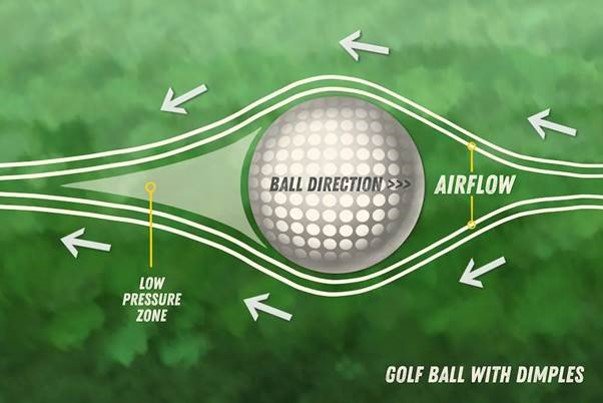
If you’ve ever wondered how many dimples on a golf ball contribute to its flight, it helps to understand what those small indentations actually do. Strip a dimpled ball down to a smooth sphere and it would fly shorter, lower and less predictably. The dimples do two jobs.
They cut drag. When a ball travels through the air, the air has to flow around it and rejoin behind it. On a smooth ball, that flow peels away from the surface early, leaving a big, messy pocket of turbulent air behind the ball that effectively pulls it backwards. Dimples stir up the thin layer of air hugging the surface, which helps it stay attached for longer. The wake behind the ball shrinks, drag falls, and the ball carries further.
They help create lift. A well-struck iron or driver sends the ball off with backspin. That spin, working together with the dimpled surface, produces higher pressure underneath the ball and lower pressure above it. The result is lift, the force that keeps the ball climbing and then holds it up on its way down.
Put simply, dimples turn a ball that would drop out of the sky into one that flies like it means it.
Where Did Golf Ball Dimples Come From?
Dimples were a happy accident before they were a design feature. Early golf balls were smooth, and the story goes that players noticed older, battered balls flew better than shiny new ones. Makers took the hint and began roughing up the surface deliberately. The best-known result was the “bramble” ball, covered in raised bumps rather than dents.
The dimple as we know it is usually credited to an Englishman, William Taylor, who was granted a British patent in 1908 for a ball with indentations that flew better and more accurately than the bramble. You’ll sometimes see claims online that Taylor founded TaylorMade. He didn’t; that’s a mix-up between two similar names.
More than a century on, the basic idea hasn’t changed. What has changed is how precisely engineers can shape and arrange the dimples.
Do More Dimples Mean More Distance?
This is where plenty of golf chat goes wrong. Some people insist more dimples always means a higher flight. Others swear fewer dimples gives more distance. Neither claim holds up, because the count on its own tells you very little.
Think of it like tyre treads. Counting the grooves won’t tell you how well a tyre grips; you need to know their depth, width, shape and layout. Golf balls work the same way. Designers tweak:
- Dimple depth and diameter
- Dimple shape and edge profile
- The mix of sizes used across the ball
- The pattern and symmetry of the layout
Titleist alone sells balls with 388, 376, 352, 350, 348 and 346 dimples, and each is tuned for a particular flight. The Pro V1 (388) and Pro V1x (348) sit side by side in the range, yet the Pro V1x is designed to fly higher. Likewise, the TaylorMade TP5 (322 dimples) and the Pro V1 (388) are both premium urethane tour balls, but the differences in how they fly and feel come as much from core construction and cover material as from dimples.
So if someone tells you that a ball is better because it has 20 more dimples, politely smile and move on.
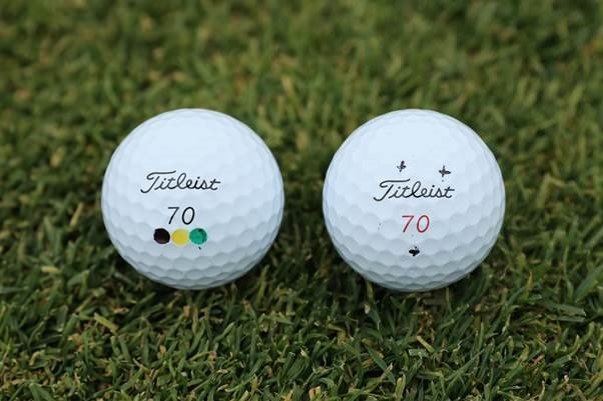
Why Are Golf Ball Dimples Different Shapes and Sizes?
Golf ball manufacturers use different dimple patterns because small changes to the surface can affect airflow. If you’re researching how many dimples on a golf ball make a difference, the design is just as important as the count.
Some designs use dimples that look almost circular, while others use patterns with different geometric arrangements. The dimples can differ in both depth and width, with each design influencing how air moves around the ball. Golf ball makers fine-tune these surface features to influence how the ball travels through the air and maintains a steady flight.
The way dimples are positioned and distributed across the ball also affects its aerodynamic performance. Their distribution across the ball’s surface is carefully designed to achieve the desired aerodynamic effect.
As a result, two golf balls with an identical dimple count may not perform in the same way. To get a clearer picture of how a golf ball behaves in flight, look at its overall dimple design instead of focusing solely on the total count.
What Do The R&A Rules Say About Dimples?
The R&A, which administers the Rules of Golf in Britain and across most of the world alongside the USGA, doesn’t limit dimple numbers at all. What it does regulate is the ball itself under the Rules of Golf – Rule 4.
- Diameter: no smaller than 42.67mm (1.680 inches)
- Weight: no more than 45.93g (1.620oz)
- Symmetry: the ball must not be designed or made to behave differently from a spherically symmetrical ball
- Performance: it must stay within overall distance and velocity limits
Inside those boundaries, manufacturers are free to experiment. If you play in competitions, it’s worth checking that your ball appears on the R&A’s list of conforming golf balls, particularly if you’re buying something unusual or a novelty ball.
Why Dimples Matter on British and Irish Courses
Anyone who has played a links course in a stiff breeze knows how much the wind can change a round. Cold mornings, damp air and gusty sea-side conditions all affect ball flight, and that’s why the dimple conversation feels so relevant in the UK and Ireland.
Manufacturers market particular dimple designs with this in mind. Srixon, a brand with roots in Dunlop’s golf business, promotes its Speed Dimple technology for stability into the wind, for instance. Other makers emphasise flatter, more penetrating flights or higher, softer-landing ones.
You shouldn’t take marketing at face value, but it does point to something real: if your home course is exposed, how a ball behaves in the wind is worth testing for yourself, rather than assuming the most expensive option suits you.
Common Mistakes and Tips When Choosing a Golf Ball
Knowing how many dimples a golf ball has can be useful, but it should not be the deciding factor when choosing the right ball for your game.
Keep these key factors in mind when selecting a golf ball that suits your game:
1. More dimples do not automatically mean greater distance. A golf ball’s aerodynamics are shaped by its overall dimple design, rather than the total number of dimples alone.
2. Research the specific ball model. Manufacturers often use different surface designs across their product ranges, so check the details of the exact ball you’re considering.
3. Match the ball to your game. Think about the distance you achieve, the feel you prefer, and how much spin and control you need around the greens.
4. Consider the construction as a whole. The cover, number of layers and aerodynamic design all play a part in how a golf ball performs during a round.
5. Look beyond individual specifications. A higher dimple count doesn’t automatically make a golf ball a better fit for your swing. Compare its overall features and consider how they suit your playing ability and preferences.
Choosing the right ball involves more than its dimple count, so learn how to choose a suitable golf ball that matches your swing, playing style and skill level.
How to Choose a Golf Ball (Without Counting Dimples)
Here’s a more useful checklist than a dimple tally:
- Know your swing speed. Slower swingers often do better with lower-compression balls; faster swingers can use firmer, tour-style balls.
- Think about your short game. Urethane covers generally give more greenside spin than surlyn covers, but cost more.
- Decide what you want from the flight. Higher, lower or penetrating? Ask your local pro or use a fitting session.
- Test in real conditions. Take a few different sleeves out on a breezy day and note how each one behaves.
- Consider the price per round. If you lose several balls a round, a tour ball may not be the best use of your money.
Frequently asked questions
How many dimples are on a golf ball?
Most golf balls have between about 300 and 400 dimples. The figure varies by manufacturer and model, and there’s no official number required by the Rules of Golf.
How many dimples does a Titleist Pro V1 have?
The current Pro V1 is generally quoted at 388 dimples, while the Pro V1x is quoted at 348. Earlier generations had different counts, so older articles may show different numbers.
Why do golf balls have dimples?
Dimples reduce air drag and help produce lift. This lets the ball fly further and more steadily than a smooth ball would.
Do more dimples make a golf ball go further?
Not by themselves. Distance depends on the overall design, including dimple depth, shape and pattern, as well as the ball’s core and cover, and your swing speed.
Are there rules about the number of dimples on a golf ball?
No. The R&A and USGA set limits on size, weight, symmetry and performance, but not on how many dimples a ball has.
Who invented golf ball dimples?
Englishman William Taylor is usually credited with the dimpled design, having received a British patent in 1908. Earlier balls used smooth surfaces or raised bramble patterns.
Are all dimples on a golf ball the same size?
Not always. Many designs use several dimple sizes and shapes to cover as much of the surface as possible and fine-tune the flight.
Does the dimple count matter for amateur golfers?
Only indirectly. What matters is how a particular ball suits your swing and the conditions you play in. The dimples are part of that design, but you don’t need to count them.
Can a golf ball fly without dimples?
Yes, a smooth ball can travel through the air, but it experiences greater aerodynamic drag than a suitably dimpled golf ball. Dimples help improve flight efficiency and distance.
The Bottom Line
So, how many dimples on a golf ball? Typically between 300 and 400, with the mid-300s being common. But that number is just one small piece of a much bigger design puzzle. Cores, covers and dimple patterns all work together, and the best ball for you is the one that flies and feels right on your home course.
Next time you’re choosing a ball, skip the counting and head out with a few sleeves to test them properly. For more practical advice on golf equipment and choosing the right gear, explore the guides and recommendations available at GolfersTee. Your scorecard will tell you more than any dimple count ever could.