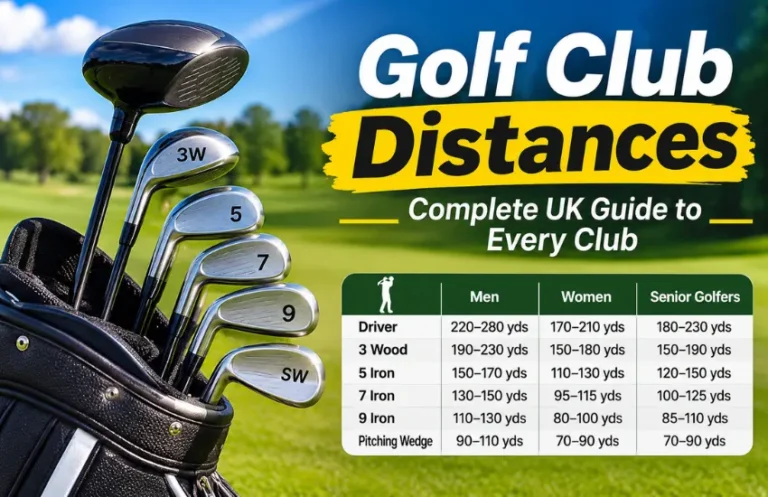
Every golfer hits their clubs different distances, so understanding your typical yardages can help you select the right club for each shot. This golf club distances guide explains typical yardages, the difference between carry and total distance, and how to build a reliable distance chart for your own game. Use the figures as a starting …
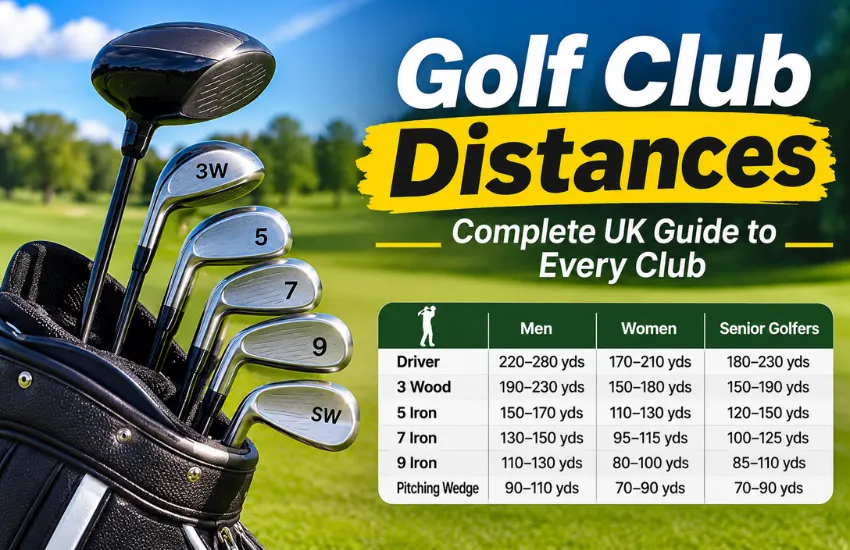
Every golfer hits their clubs different distances, so understanding your typical yardages can help you select the right club for each shot. This golf club distances guide explains typical yardages, the difference between carry and total distance, and how to build a reliable distance chart for your own game. Use the figures as a starting point, then adjust them to match your swing and playing conditions.
Golf Club Distances Chart: How Far Does Each Club Go?
How far the ball travels is influenced by your swing speed, quality of contact, club loft and the conditions on the course. The table below provides a useful benchmark from professional golf, rather than a prediction of what an amateur should hit.
TrackMan’s published 2023-season tour averages give the following carry distances for PGA Tour players. These are elite-player figures, so recreational golfers should not treat them as targets.
| Golf club | Average carry distance (yards) |
| Driver | 282 |
| 3-wood | 249 |
| 5-wood | 236 |
| 4-iron | 209 |
| 5-iron | 199 |
| 6-iron | 188 |
| 7-iron | 176 |
| 8-iron | 164 |
| 9-iron | 152 |
| Pitching wedge | 142 |
Important: These figures represent professional carry distances, not average UK club-golfer distances. Reliable yardages for your own game should come from measuring your shots. Gap, sand and lob wedge distances also need to be assessed individually.
What Is the Average Golf Club Distance for Amateurs?
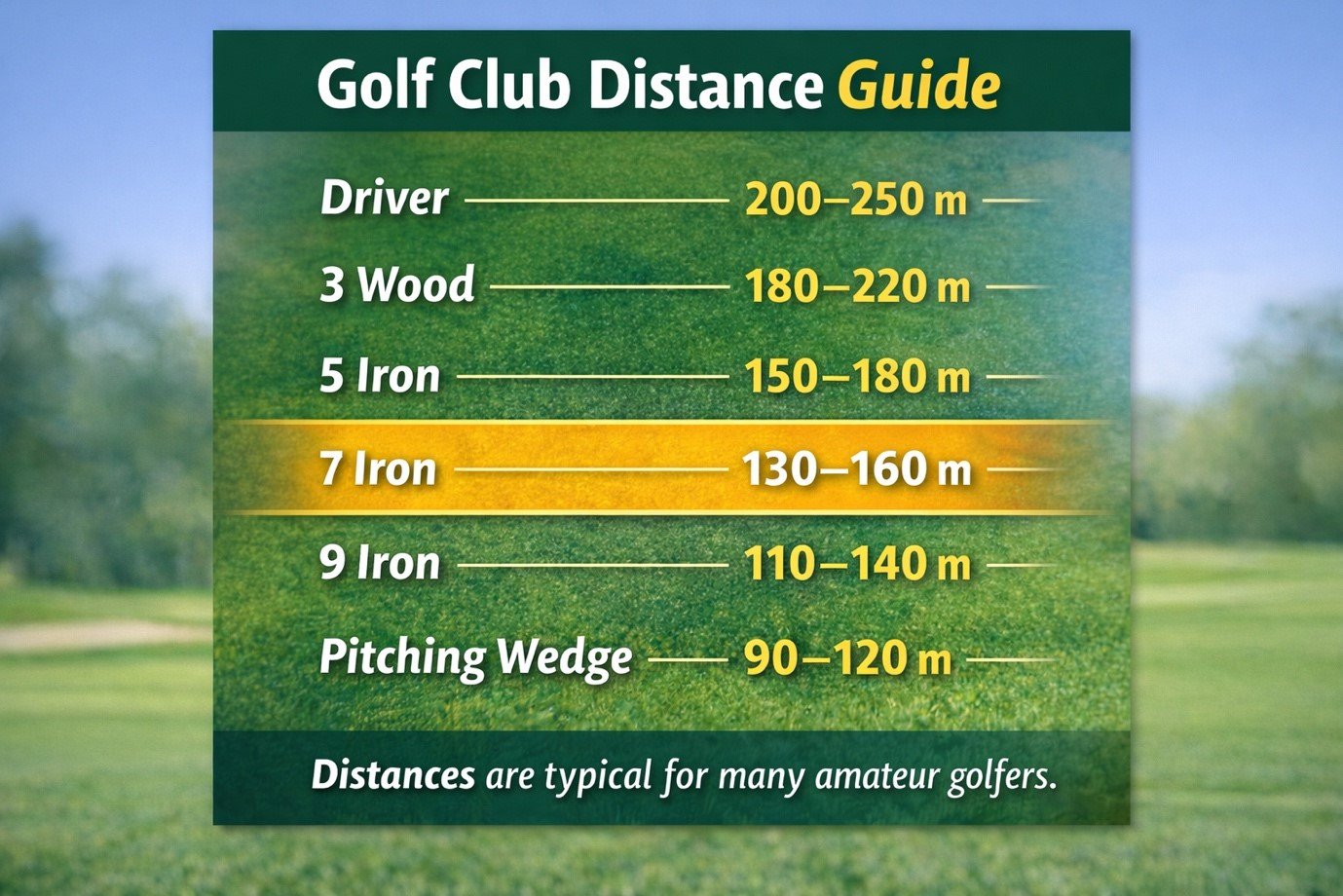
There is no single distance chart that suits every amateur golfer. A beginner learning to make consistent contact may hit the ball considerably shorter than an experienced player with a faster swing.
The following factors help explain why two golfers using the same club can achieve very different distances.
- Swing speed: Faster clubhead speed generally creates greater distance when contact and launch conditions are suitable.
- Strike quality: Hitting the centre of the clubface usually produces better results than striking the heel, toe or ground first.
Improving your technique and developing a more consistent swing can also help you get better results with each club. Beginners can explore some practical ways to improve their golf swing and build confidence on the course.
- Club design: Loft, shaft characteristics and clubhead design all influence launch and distance.
- Age and physical ability: Changes in flexibility, strength and swing speed can affect how far you hit the ball.
- Weather and course conditions: Wind, temperature, elevation and ground firmness can change the result.
Rather than comparing yourself with professional golfers, focus on consistency. If your 7-iron regularly carries 135 yards, for example, that is more useful information for choosing a club than knowing that a tour player carries theirs 176 yards.
Carry Distance vs Total Distance
Knowing how carry distance differs from total distance makes it easier to interpret a golf club distance chart.
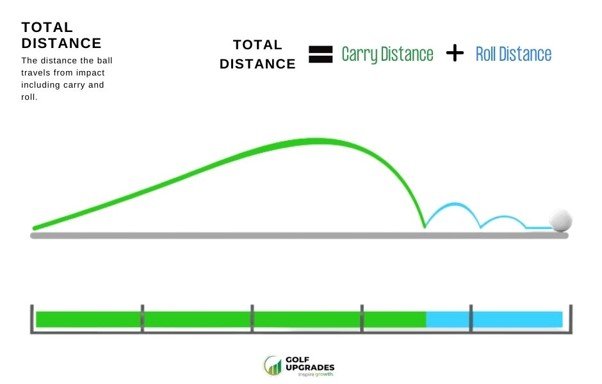
Carry Distance: refers to the length the ball travels through the air before it touches the ground.
Total distance includes the additional ground it covers after landing.
The difference depends on factors such as the club, landing angle, spin, wind and firmness of the ground.
For example, a drive that carries 220 yards and rolls another 20 yards finishes 240 yards from its starting point. These figures are an illustration, not an average for all golfers.
Carry distance is particularly important when approaching greens, clearing bunkers or playing over water. If the front of a green is 130 yards away, you need to know whether your chosen club can carry the ball far enough to reach it.
For tee shots on a dry, firm course, total distance may be more relevant. On a wet UK course, where the ground offers less roll, carry distance often becomes especially useful.
How Far Should You Hit a Driver?
The driver is generally the longest club in the bag and is designed primarily for tee shots. Its purpose is to help you cover as much distance as practical while keeping the ball in a playable position.
Your driving distance depends on swing speed, strike quality, launch conditions and the amount of roll after landing. A powerful swing does not automatically produce a long drive if the ball is struck poorly.
To establish your normal driver distance, record several shots rather than using your longest drive as the benchmark. Include ordinary strikes and exclude obvious mishits only if you are calculating your typical distance from reasonably well-struck shots.
Also consider accuracy. A slightly shorter drive in the fairway may leave you in a better position than a longer shot in thick rough or behind trees.
How Far Should You Hit Each Iron?
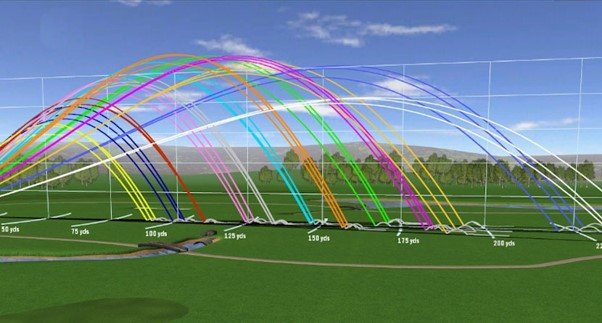
Irons help you manage approach shots and control distances as you move towards the green. Lower-numbered irons generally have less loft and are designed to travel farther than higher-numbered irons when struck under comparable conditions.
You can also learn more about the history and design of golf clubs, including how different types are used during a round.
However, modern iron sets can have different lofts, so the number printed on a club does not guarantee a particular distance.
Long irons: 3-iron and 4-iron
Long irons are designed for longer shots, but they can be difficult to launch consistently. Some golfers prefer hybrids or higher-lofted fairway woods because these clubs better suit their swing and strike pattern.
Mid-irons: 5-iron, 6-iron and 7-iron
Mid-irons offer a balance between distance and control. The 7-iron is a useful reference club because many golfers find it easier to hit consistently than a long iron.
Note your typical carry distance along with how consistently you achieve it. If your 7-iron sometimes flies 140 yards and sometimes 160 yards, choosing a club based on the best result could leave you short or long more often than expected.
Short irons: 8-iron and 9-iron
Short irons are used for shorter approach shots. They typically launch the ball higher than long irons and can help golfers target greens more accurately.
Practise hitting to specific distances rather than trying to maximise every shot. A controlled swing that produces a predictable yardage is often more useful than an occasional extra-long strike.
How Far Should You Hit Your Wedges?
Wedges are designed for shorter approach shots, pitches and shots around the green. They are particularly important for controlling distance and getting the ball close to the hole.
The main types are:
- Pitching wedge: Often used for fuller approach shots and lower pitches.
- Gap wedge: Helps bridge the distance between a pitching wedge and a sand wedge.
- Sand wedge: Commonly used for bunker shots, pitches and shorter approaches.
- Lob wedge: Offers extra loft for situations where a high shot and a short landing are useful.
Wedge distances are especially individual. Different lofts, swing lengths and shot techniques can produce very different results.
Practise full, three-quarter and half swings with each wedge. Record the carry distance for each one so you can select a suitable shot when you need to cover a particular yardage.
Pay attention to the distance gaps between wedges. If two clubs travel almost the same distance on a full swing, you may need to review your loft setup or practise different swing lengths.
How to Measure Your Golf Club Distances
Building your own golf club distances chart is straightforward. You can use a launch monitor, a practice range with measured targets or carefully recorded shots on the course.
Follow these steps:
- Choose a suitable practice area. Use a driving range or launch monitor where distances can be measured reliably.
- Warm up first. Make a few comfortable swings before recording your results.
- Hit several shots with each club. Aim for around 5–10 reasonably representative shots rather than relying on one strike.
- Record carry distance. If possible, use a launch monitor that distinguishes carry from total distance.
- Calculate your typical yardage. Use the average or median of your representative shots, rather than your longest result.
- Repeat the process. Check your distances periodically and note changes in conditions or technique.
The USGA has studied recreational golfers’ estimated distances against measurements taken with TrackMan launch monitors. Its research highlights the value of measuring actual performance instead of relying solely on what golfers believe they hit.
Example golf club distance tracker
Use a simple table to keep your numbers organised.
| Club | Carry distance | Total distance |
| Driver | Your measured yardage | Your measured yardage |
| 3-wood | Your measured yardage | Your measured yardage |
| 5-wood or hybrid | Your measured yardage | Your measured yardage |
| 7-iron | Your measured yardage | Your measured yardage |
| 9-iron | Your measured yardage | Your measured yardage |
| Pitching wedge | Your measured yardage | Your measured yardage |
| Sand wedge | Your measured yardage | Your measured yardage |
Fill in the table with your own results. If you do not have a way to measure carry and roll separately, record the distance you can measure and label it clearly.
Common Golf Club Distance Mistakes
Even experienced golfers can make poor club selections when they misunderstand their yardages. Avoid these common mistakes.
- Using your best shot as your normal distance
An exceptional strike is not necessarily representative of your usual performance. Base your decisions on a repeatable distance.
- Confusing carry with total distance
A shot that travels far on a firm fairway may not achieve the same result on wet ground. Check which distance matters for the shot ahead.
- Ignoring the wind
A headwind can reduce distance, while a tailwind can help the ball travel farther. Adjust your club choice to suit the conditions.
- Assuming every 7-iron travels the same distance
Club lofts and designs differ between manufacturers and models. Your own measured yardage is more reliable than a generic chart.
- Trying to hit every shot as hard as possible
A smooth, controlled swing can improve consistency. Distance is only useful when you can also control direction and trajectory.
FAQs About Golf Club Distances
How far does the average golfer hit a 7-iron?
There is no universal average because swing speed, ability and club loft vary. TrackMan’s published PGA Tour average carry distance is 176 yards, but recreational golfers should measure their own 7-iron distance rather than use professional figures as a target.
How far should a beginner hit a golf ball?
Beginners can have a wide range of distances while learning to make consistent contact. Instead of chasing a particular yardage, concentrate on solid strikes, a repeatable swing and knowing how far the ball travels with each club.
Does age affect golf club distances?
It can. Changes in strength, flexibility and swing speed may affect distance as golfers get older. However, age alone does not determine how far someone can hit a golf ball.
Should I use carry or total distance when choosing a club?
Use carry distance when you need the ball to reach a target in the air, such as a green beyond a bunker. Total distance is useful when planning tee shots and estimating where the ball will finish after rolling.
Final Thoughts
Knowing your golf club distances can help you make better decisions, improve course management and choose clubs with greater confidence. Start with a general chart for context, then build your own by measuring representative shots and recording carry distances. Consistency matters more than matching professional yardages.
Having the right equipment can also make a difference to your comfort and performance on the course. If you’re considering an upgrade, explore our guide to the best golf shoes to find a pair that suits your playing style and course conditions.